DSLR Lunar Astrophotography: Capturing the Mineral Moon at 500mm
15 Apr 2025By Akshay Kumar
Photographing the Moon at 500mm: A DSLR Foundation
The Moon is often the first true celestial target for anyone pointing a camera skyward. From the heavily light-polluted Bortle 8 skies of Bhagalpur, it remains an anchor point that completely cuts through the urban glow. Over the past few years, I have repeatedly returned to the lunar surface to refine my acquisition and processing techniques. Rather than relying on dedicated planetary cameras and massive focal lengths right away, I spent significant time mapping the Moon using standard terrestrial photography gear.
All the data in this session was captured using a Nikkor 200-500mm lens locked firmly at 500mm. The camera bodies rotated between a Nikon D5300 and a Nikon Z8, either mounted on a basic tripod or shot completely handheld. It is easy to assume that deep crater definition and mineral color distribution require a large telescope. However, photographing the moon with a telephoto lens under calm atmospheric seeing conditions proves just how much structural detail a standard 500mm focal length can resolve.
Daytime Lunar Astrophotography: Capturing the Evening Gibbous
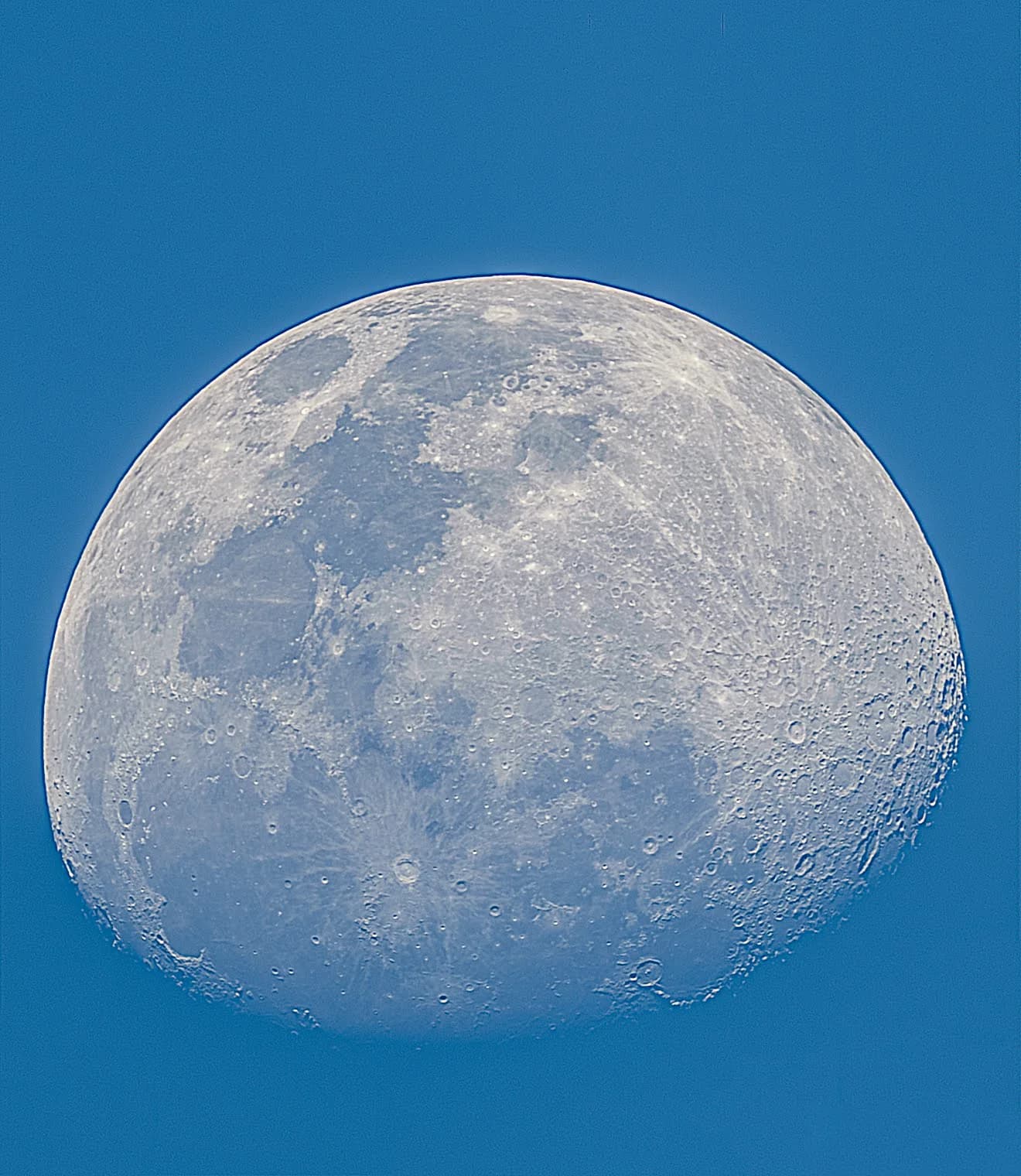
While the Moon is universally associated with the night sky, daytime lunar astrophotography is possible far more often than many realize, particularly during the waxing and waning gibbous phases. Capturing the lunar surface prior to twilight places it in a highly unusual context. The resulting image reveals a striking contrast between the bright, sunlit highlands and the flat, dark plains of the lunar maria, all set against the blue gradient of Earth's atmosphere.
What makes daytime or early evening captures challenging is the low contrast environment. The sky is still scattering sunlight, which washes out the fainter geological features. Despite these conditions, shooting at 500mm with a fast shutter speed still resolves the major "seas" like Mare Imbrium and Mare Serenitatis. These dark regions are actually ancient lava plains formed billions of years ago during the Moon's active volcanic past. Seeing them suspended in a bright blue sky offers a unique perspective on our nearest celestial neighbor.
The DSLR Burst Method: Stacking Lunar Images in AutoStakkert
Capturing high-resolution lunar details requires overcoming atmospheric turbulence. Dedicated planetary imagers use high-speed video cameras to capture thousands of frames in seconds, relying on a technique known as lucky imaging to freeze the atmosphere. Working with DSLR and mirrorless bodies requires a modified approach. Instead of shooting video, I rely on continuous high-speed burst shooting in RAW format to gather between 300 and 500 frames per session. This ensures maximum dynamic range and resolution, but it demands strict discipline in acquisition and processing.
This burst method heavily taxes camera hardware and highlights the massive generational gap between sensors. The older Nikon D5300 struggles with a small buffer and a very slow frame rate when capturing uncompressed RAW files. That sluggish speed makes it difficult to catch the brief, unpredictable moments of steady air. Moving to the Nikon Z8 completely changed the acquisition dynamic. The Z8 features a virtually bottomless buffer and a significantly faster burst rate, allowing the sensor to punch through the atmospheric seeing and secure a much higher yield of sharp frames before the air column shifts.
Processing the Mineral Moon: Revealing Lunar Chemistry
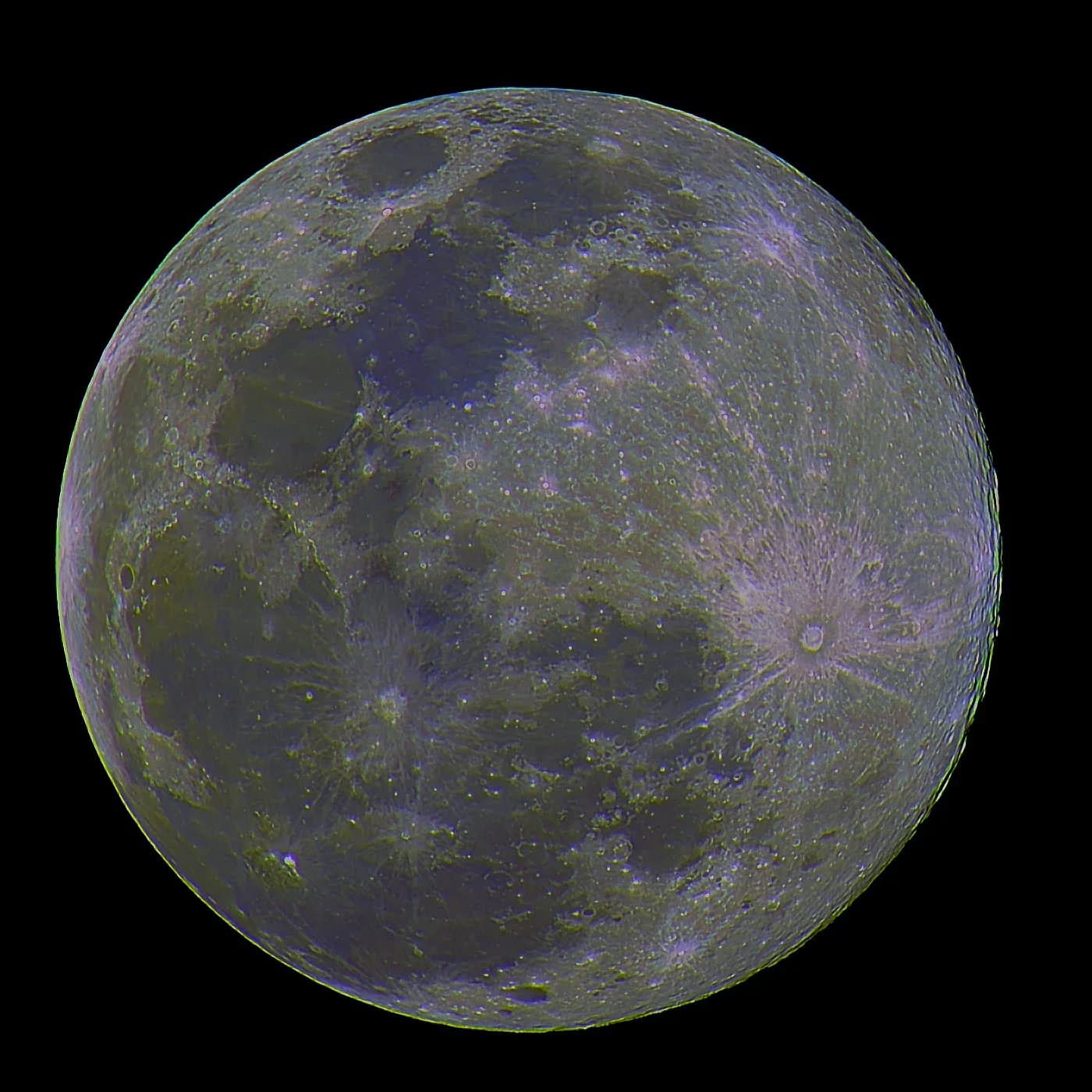
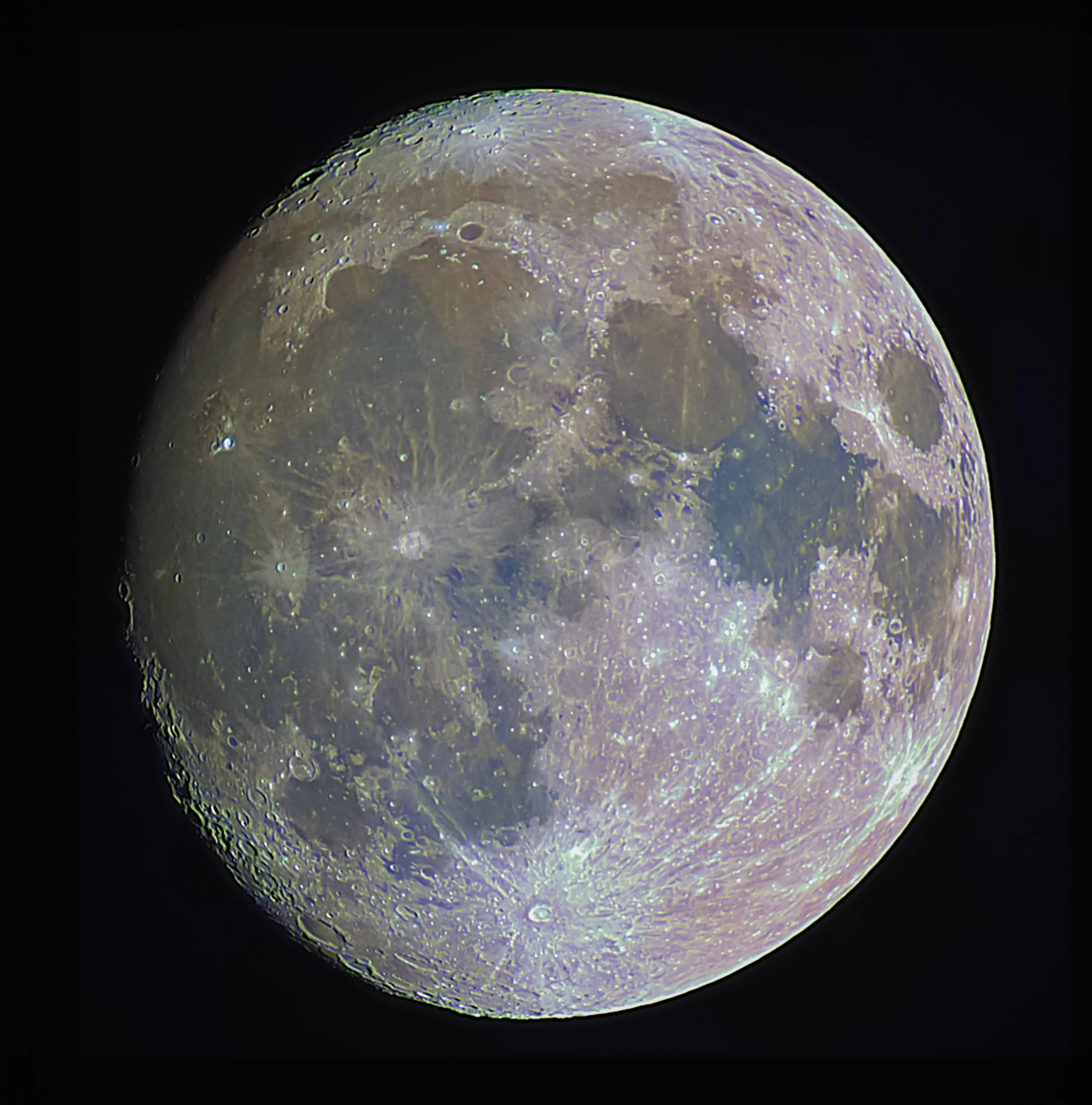
At first glance, the Moon always appears to be a simple, monochromatic sphere of gray and white. There is, however, a much more complex geological story hiding in plain sight. By capturing high-quality RAW data and carefully pushing the color depth during post-processing, we can reveal the subtle, natural mineral deposits distributed across the lunar surface. This specific full Moon was captured close to the festival of Holi, making the sudden explosion of color in the processing pipeline feel incredibly fitting.
The color variations you see are directly tied to the chemical composition of the lunar regolith and ancient lava flows. The prominent bluish areas within the lunar maria indicate titanium-rich basalts. In contrast, the brown and orange hues correspond to iron-rich regions or older, highly weathered surfaces that have been exposed to space for longer periods. You can also clearly trace the bright, pale streaks of ejected material radiating outward from relatively recent impact sites like Tycho Crater.
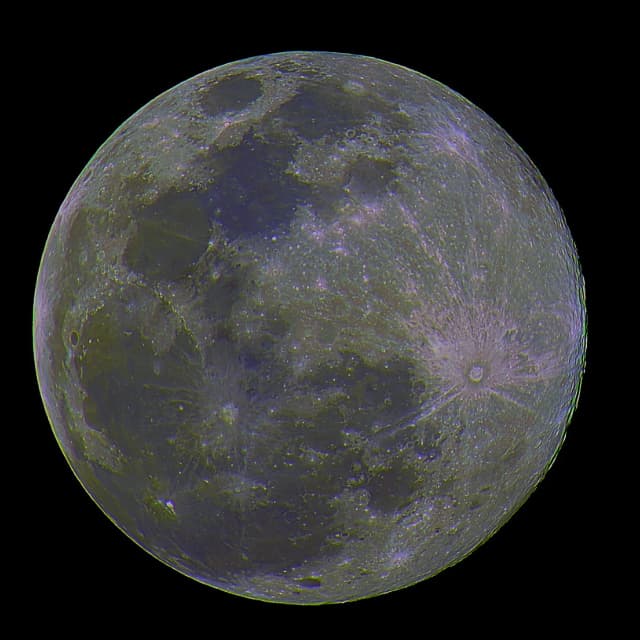
It is important to note that this is not false color. Mineral moon processing simply amplifies the faint, naturally occurring spectral differences that our eyes cannot pick up through the glare of a bright full moon.
Lunar Terminator Photography: Revealing High-Resolution Topography
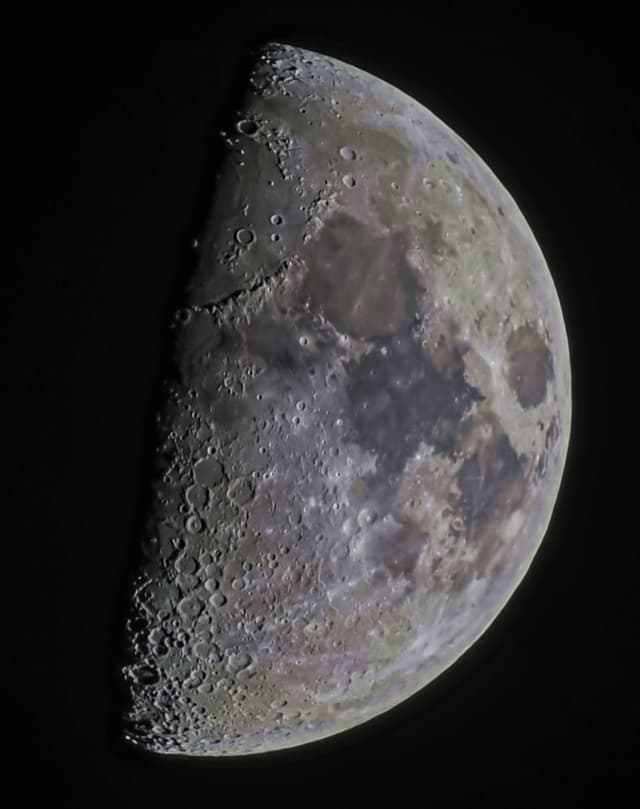
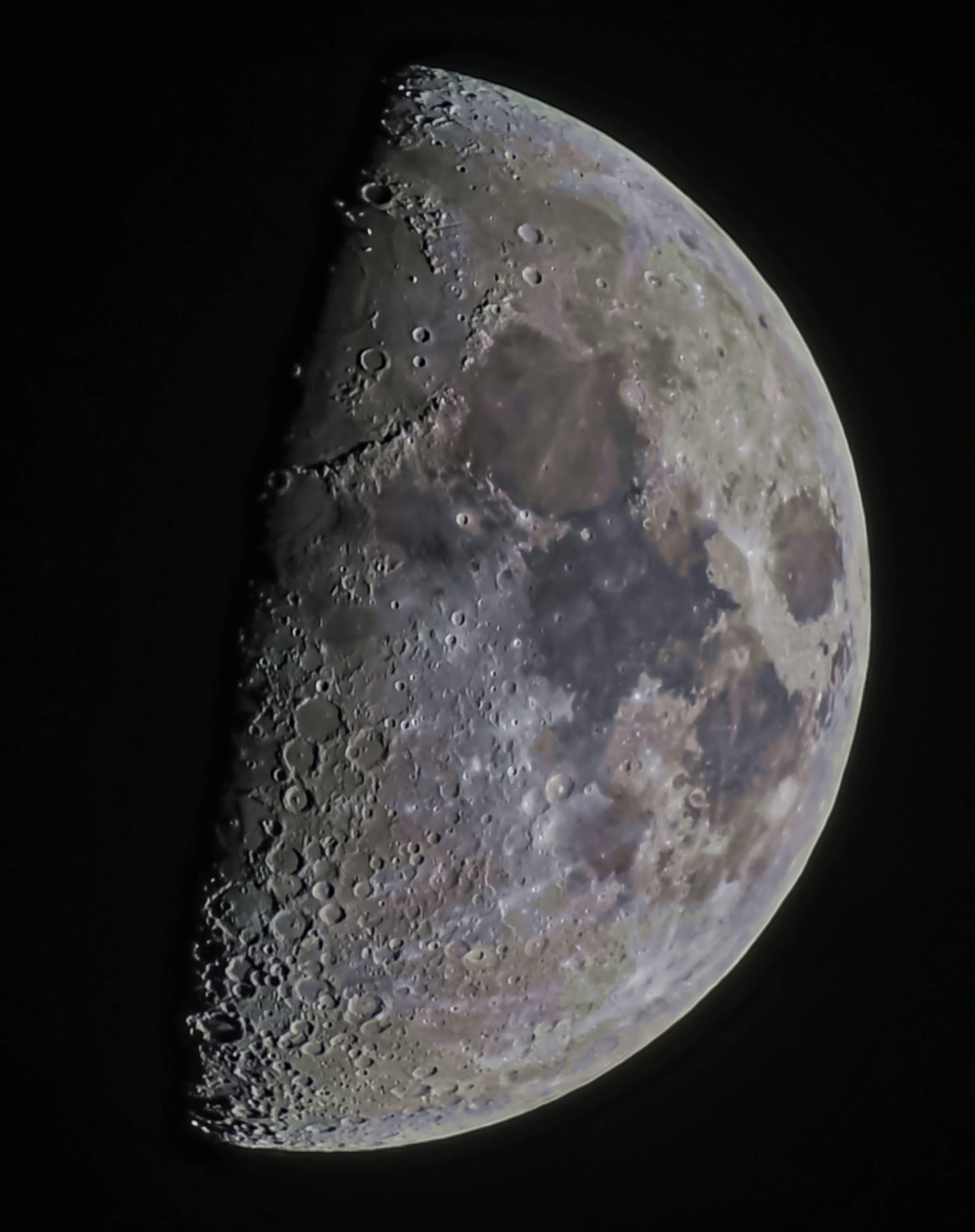
The most striking high-resolution lunar surface details are rarely found during a full moon. Instead, the best structural contrast occurs along the terminator (the moving boundary dividing the lunar day and night). Capturing this region during the waxing gibbous phase on August 17, 2024, demonstrated exactly how well a DSLR can resolve deep geological features when the lighting is optimal.
Along this dividing line, sunlight strikes the surface at a severe, low angle. This creates long, harsh shadows that heavily amplify the rugged topography of the Moon. This high-contrast environment makes it incredibly easy to distinguish prominent impact sites like Copernicus, Clavius, and Theophilus. You can clearly trace the Alps and Apennines mountain ranges as they rise sharply along the curved edges of Mare Imbrium.
The shadows also reveal the stark difference between younger craters with well-defined, sharp central peaks and ancient, eroded impact zones that have been smoothed out by eons of micrometeorite bombardment. These specific lunar phases provide the absolute best opportunity for DSLR lunar astrophotography because the natural shadows do the heavy lifting, giving the flat image a powerful sense of three-dimensional depth.
Upgrading from a 500mm Lens: High-Resolution Lunar Mosaics at 2000mm
While I spent years exploring the Moon with a 500mm telephoto lens, that focal length eventually served as a stepping stone. In February 2026, I returned to similar lunar terrain. This time, I swapped the DSLR for a dedicated ZWO ASI676MC planetary camera attached to a Celestron C8 EdgeHD.
- Optics
- Nikkor 200-500mm f/5.6
- Cameras
- Nikon Z8, Nikon D5300
- Mount
- Standard Tripod / Handheld
- Location
- Bortle 8 (Bhagalpur, India)
Shooting at a native focal length of 2032mm completely changes the required discipline. The difference in scale is immediately apparent. Geological features that barely registered as subtle textures at 500mm suddenly dominate the frame as massive crater rims and deeply layered terrain. Making this transition is not just about raw magnification. The ASI676MC features very small pixels designed for high-resolution planetary work. When paired with a 2000mm focal length, this tight pixel scale drastically increases the sampling resolution. Every minor tremor or pocket of atmospheric boiling is magnified. It demands precise collimation control and significantly shorter exposure times to freeze the seeing conditions.
Yet, all the techniques learned while balancing exposure times and stacking hundreds of DSLR frames laid the absolute foundation for this high-resolution work. The Moon never truly gets old. It simply demands a closer look.