Horsehead Nebula (B33) and Flame Nebula (NGC 2024) Astrophotography
5 Dec 2024By Akshay Kumar
Orion B33 and NGC 2024 Astrophysical Context
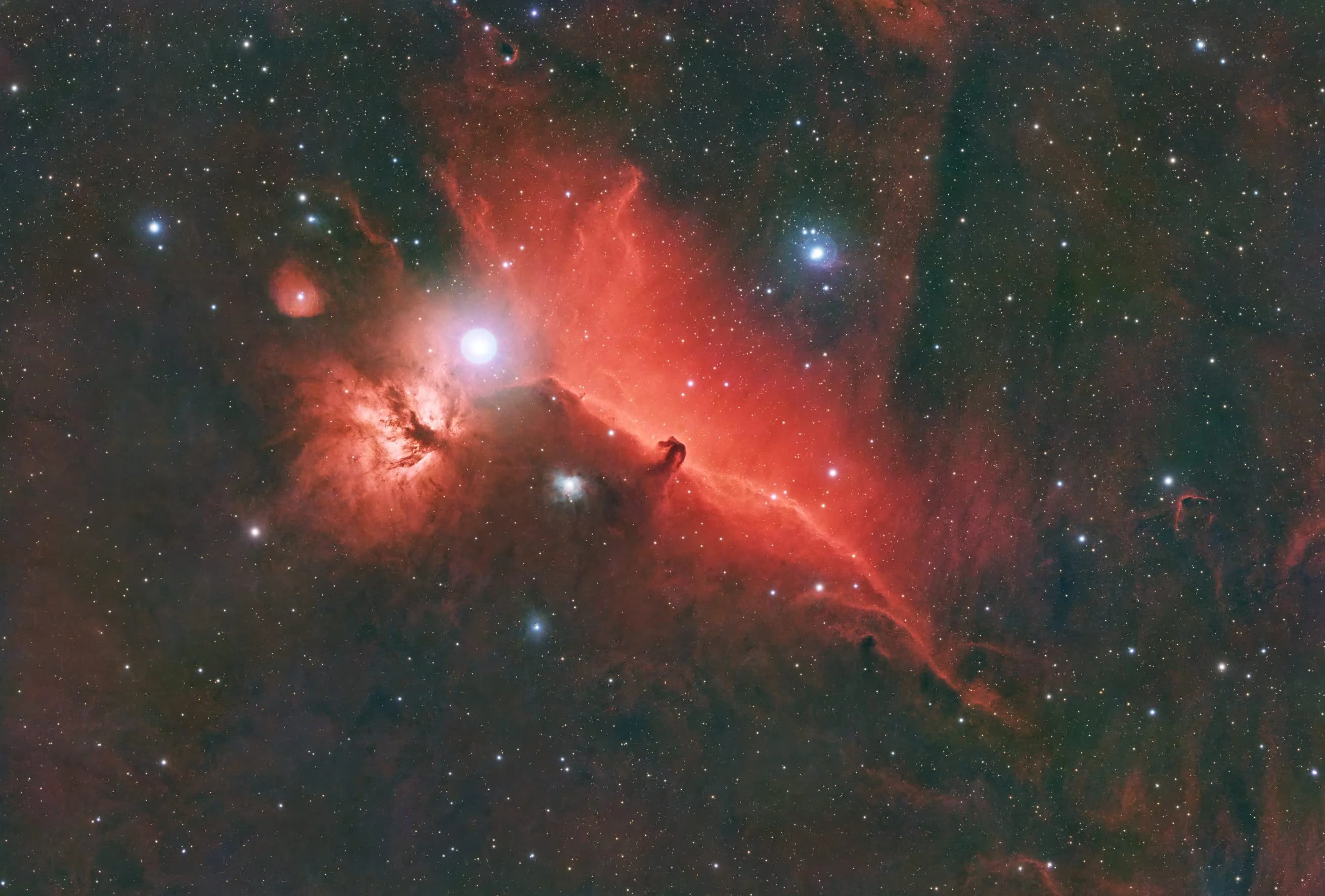
The region surrounding the Eastern Belt star, Alnitak, is a dense theater of stellar birth and radiation. At the center of this frame lies IC 434, a bright emission nebula that serves as the backlighting for the iconic Horsehead Nebula (B33). This silhouette is actually a pillar of cold, dark molecular gas and dust, approximately 1,500 light-years from Earth. It is being slowly eroded by the intense ultraviolet radiation from the nearby star Sigma Orionis, a process known as photoevaporation.
While the Horsehead commands the most attention, the field is crowded with distinct astrophysical signatures:
- NGC 2024 (The Flame Nebula): Unlike many emission nebulae powered by internal clusters, the Flame is primarily energized by Alnitak’s high-energy light ionizing the surrounding hydrogen gas. The dark network of dust crossing its center is a foreground structure obscuring the glowing gas behind it.
- NGC 2023 Reflection Nebula: This is one of the brightest reflection nebulae in the sky. It shines because a young, hot star (HD 37903) is embedded within the dust cloud, scattering its blue light.
- IC 432 and IC 431: These are smaller reflection nebulae situated further north. They represent regions where starlight is bouncing off interstellar dust grains, providing a delicate blue contrast to the dominant red H-alpha background.
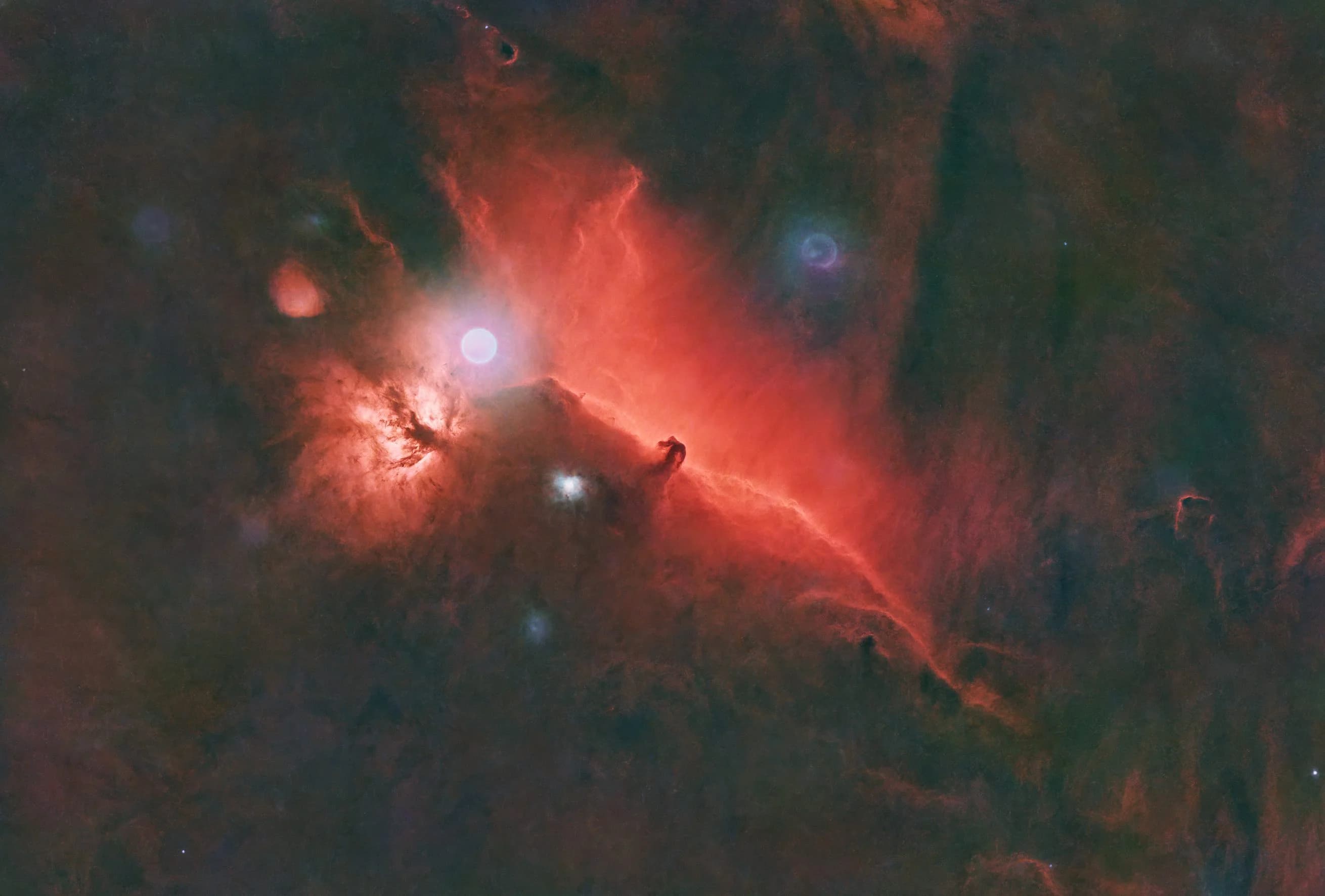
By removing the stellar interference, we can see the 'waves' of gas along the top of the Horsehead. These are shock fronts created as the radiation pressure from Sigma Orionis hits the denser molecular cloud, pushing the gas into these intricate, fluid-like shapes.
Deep-Sky Acquisition in Bortle 8 Skies
Capturing this signal during the transition into the Indian winter required navigating a shifting climate. This period marks the onset of the fog season in Bhagalpur. As the temperature drops, the humidity levels rise, creating a thin, high-altitude haze. Out of 12 total hours of data, 3 hours had to be discarded as the transparency plummeted, leaving 9 hours of high-quality signal to work with.
The primary technical adversary in this framing was Alnitak (50 ζ Ori). As a blue supergiant and the brightest O-class star in the night sky, its sheer luminosity creates massive reflection and diffraction challenges. Using the William Optics 71GT and the Optolong L-Extreme filter allowed for the isolation of the H-alpha and OIII emissions, which was critical for cutting through the Bortle 8 light pollution of the city.
Plate Solve and Target Identification
The Horsehead region is a crowded intersection of emission and reflection nebulae. Using the integrated plate-solve data, we can trace the relationship between these objects and the blinding light of Alnitak.
B33 Starless Comparison
One of the most effective ways to appreciate the sheer scale of the IC 434 emission curtain is to view the field without the overwhelming presence of the local stars. Removing the stars allows the intricate textures in the hydrogen gas to become visible, particularly the bridge of material connecting the Horsehead to the brighter regions of the Flame Nebula.
- Exposure
- 9 Hours (Net)
- Optics
- William Optics 71GT APO
- Camera
- ZWO ASI294MC Pro
- Filters
- Optolong L-Extreme
- Mount
- iOptron CEM40
- Guiding
- WO 50mm + ASI120MM
- Location
- Bhagalpur, India (Bortle 8)