Choosing Your First Astrophotography Camera: Pixel Size vs. Resolution vs. Focal Length
5 Dec 2025By Akshay Kumar
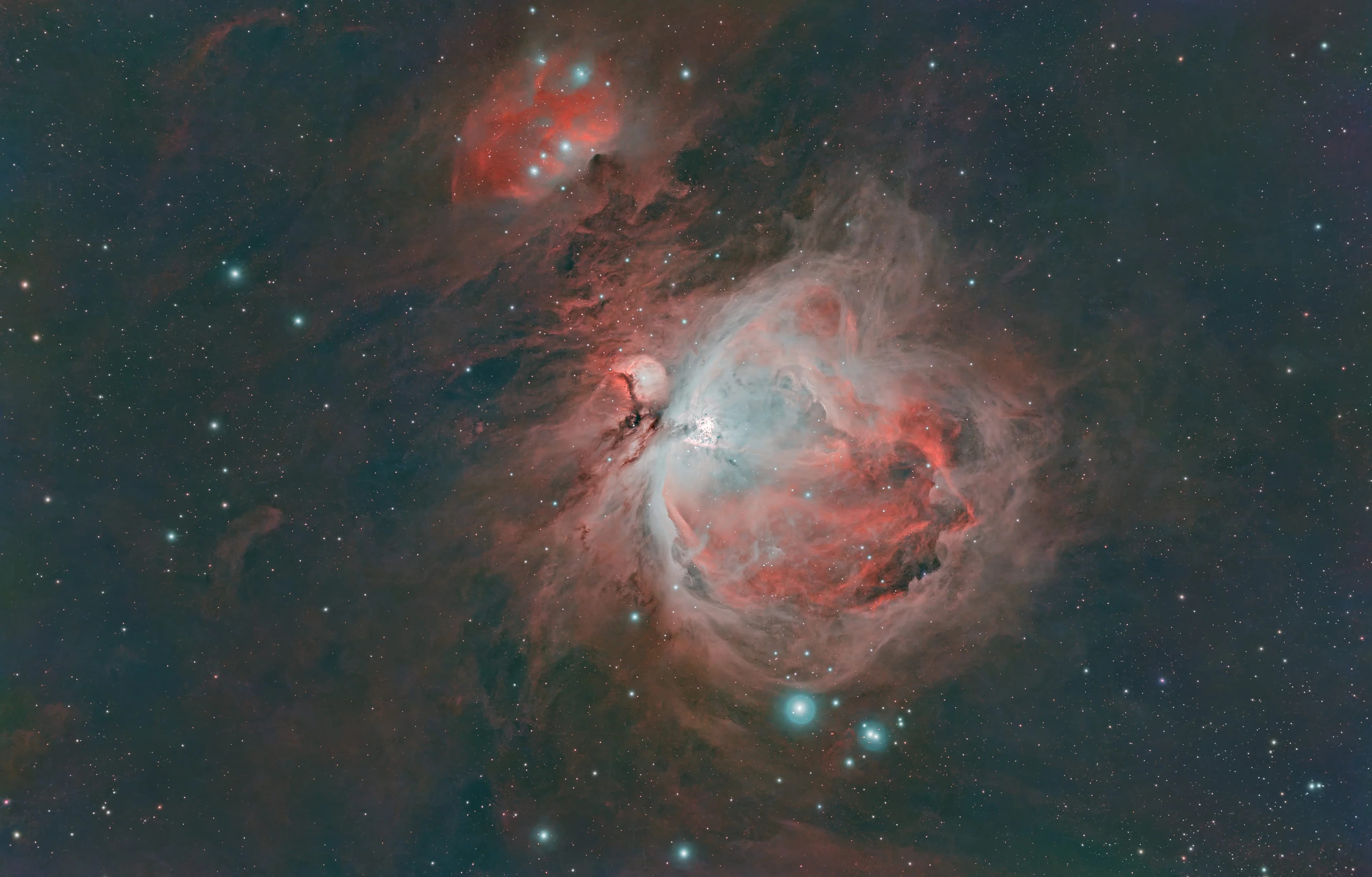
Getting started in astrophotography is often a journey that begins with what we already own. For many of us, that means a standard DSLR or mirrorless camera and a long telephoto lens. I remember being amazed that the exact same gear I used for daytime wildlife could capture the Orion Nebula from my backyard in Bhagalpur.
But as the habit deepens, we start exploring dedicated astronomy cameras, often without fully understanding what we actually need. The truth is that this hobby is incredibly cost-heavy. If you fail to take the time to learn how each piece of gear fits into your imaging goals, it can quickly become a destructive obsession. A new camera will not fix bad guiding. A higher megapixel sensor will not magically make your stars round.
This post is my attempt to map out that journey. We will examine the key lessons I have learned around sensor size, pixel size, resolution, pixel scale, and field of view.
DSLR vs. Dedicated Astrophotography Cameras: The Core Differences
In standard photography, we are taught a few basic rules. Full-frame (FX) cameras offer better low-light performance and a wider field of view with their 36x24mm sensors. Crop sensors (DX) are smaller, more budget-friendly, and make subjects appear closer than they would on a full-frame body.
In normal photography, people generally look at resolution at a high level. However, because we are shooting targets that are millions of light-years away, both sensor size and resolution become important together. They directly dictate the clarity of your final image.
Let us look at the math behind the pixels using two popular DSLR cameras:
- Nikon D850 / Z8 (FX): 45.7 million pixels on a 36x24mm sensor. Resulting pixel size is approximately 4.35µm.
- Nikon D5600 (DX): 24.2 million pixels on a 24x16mm sensor. Resulting pixel size is approximately 3.91µm.
Astrophotography Basics: Understanding Angles and Apparent Size
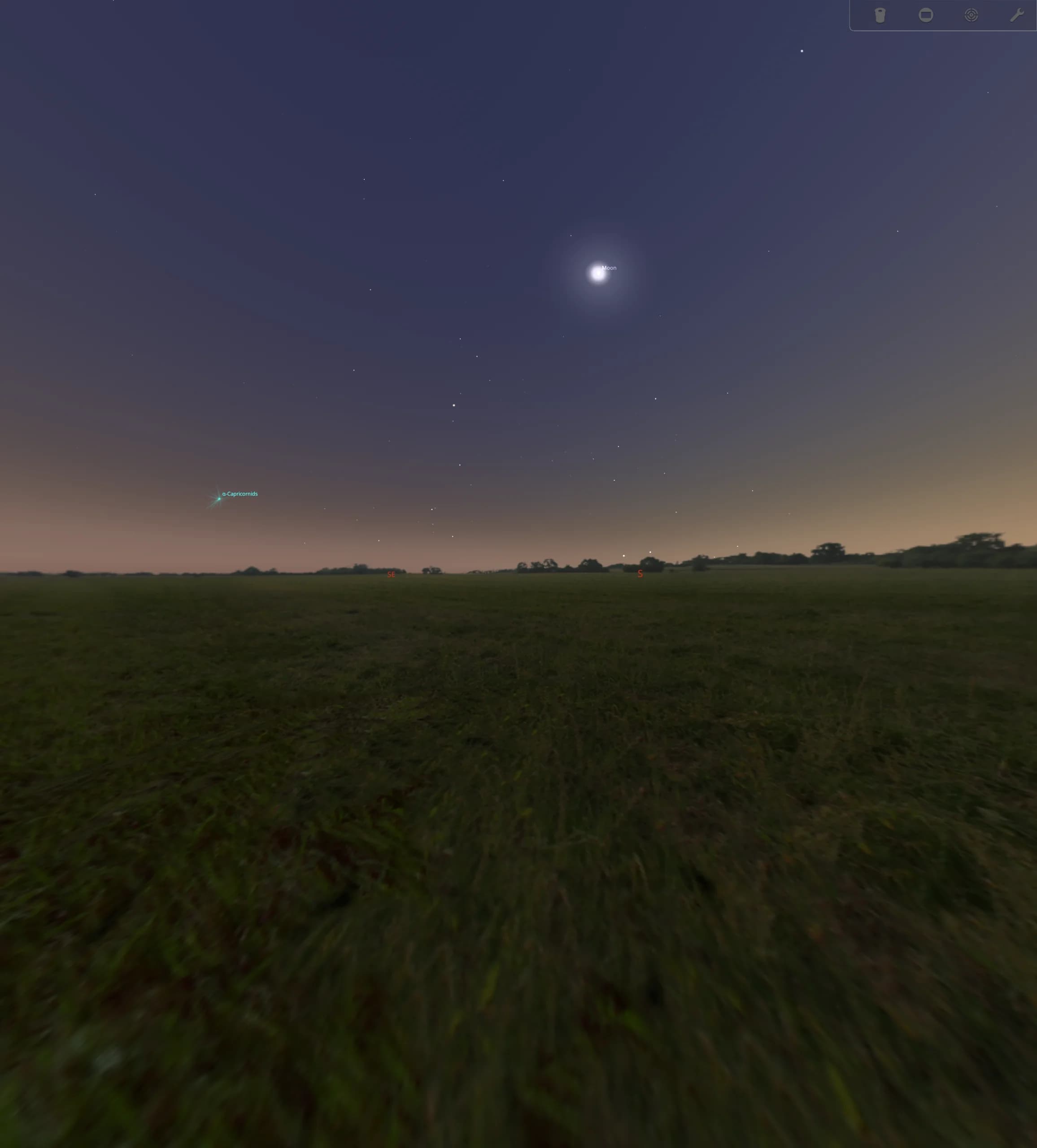
To understand astrophotography cameras, you first have to understand how we measure things in the sky. We use angles. The night sky from horizon to horizon spans exactly 180 degrees. The field of view is simply the angle subtended at your eye or your camera sensor by an object in space.
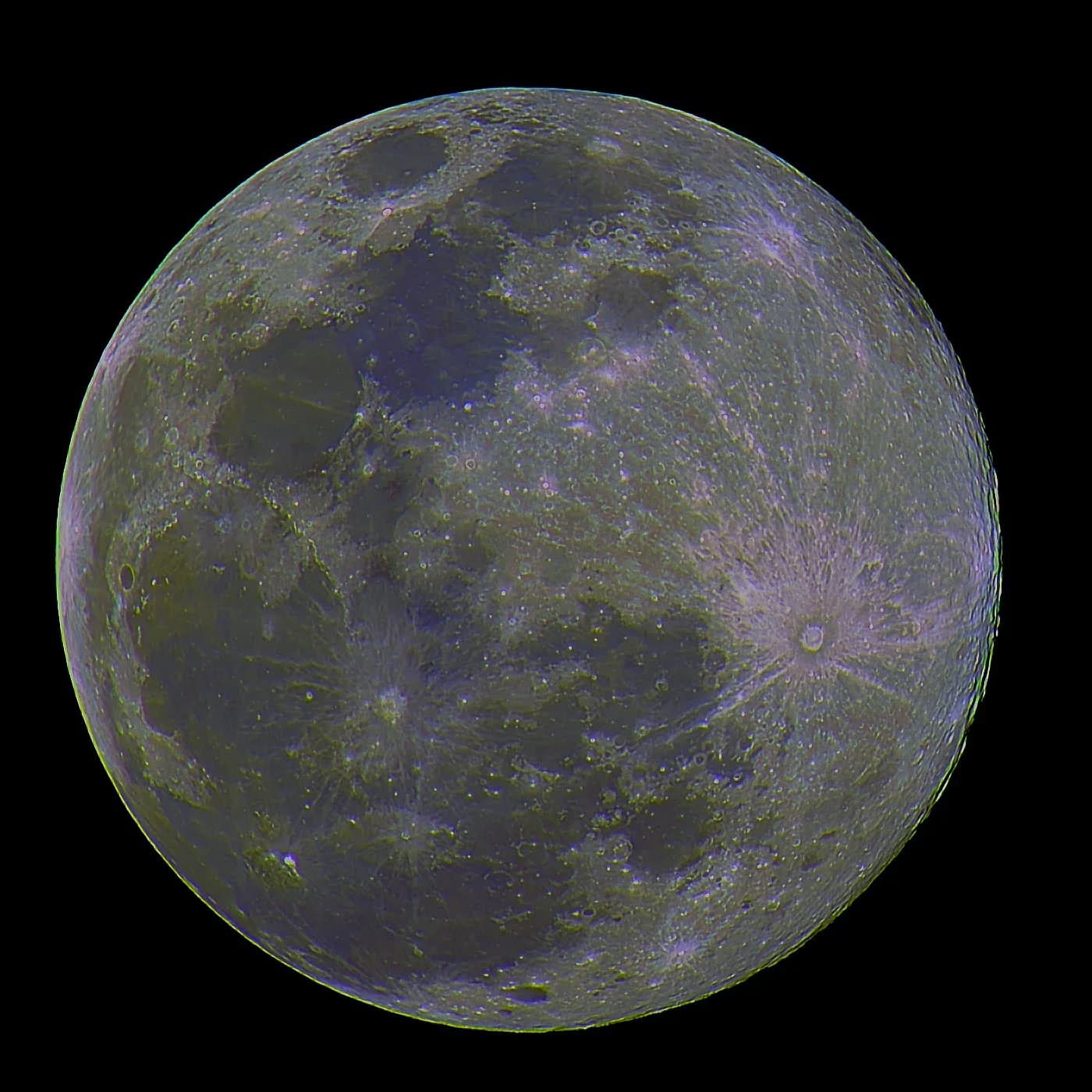
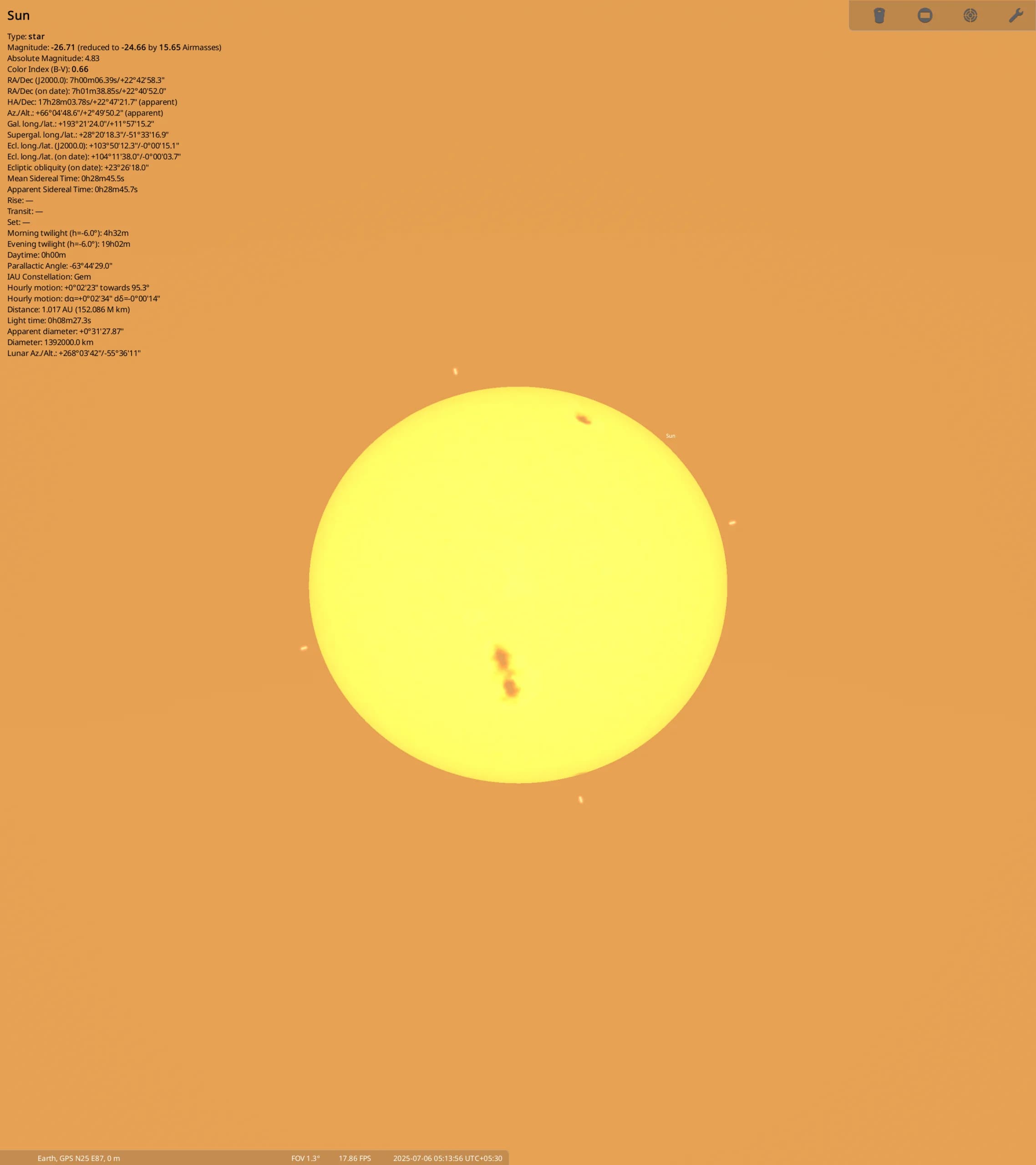
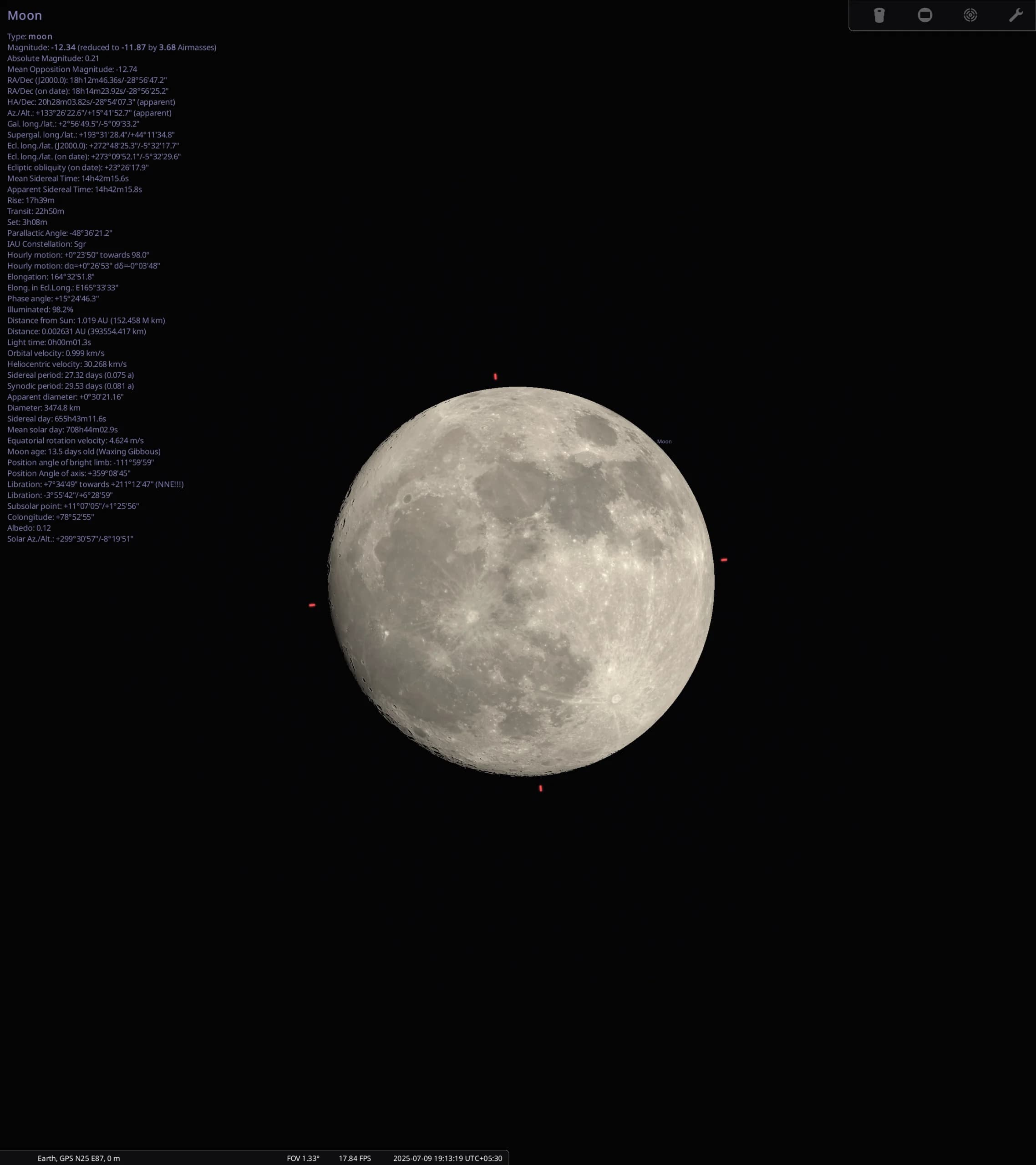
Take the Sun and the Moon. From our perspective on Earth, they both appear to be roughly the exact same size in the sky. They both span an angle of about 0.5 degrees.
This cosmic coincidence means they look identical in size to our cameras, even though the Sun is fundamentally larger (about 400 times wider) and 400 times farther away.
Framing Deep Space Objects: Field of View Explained
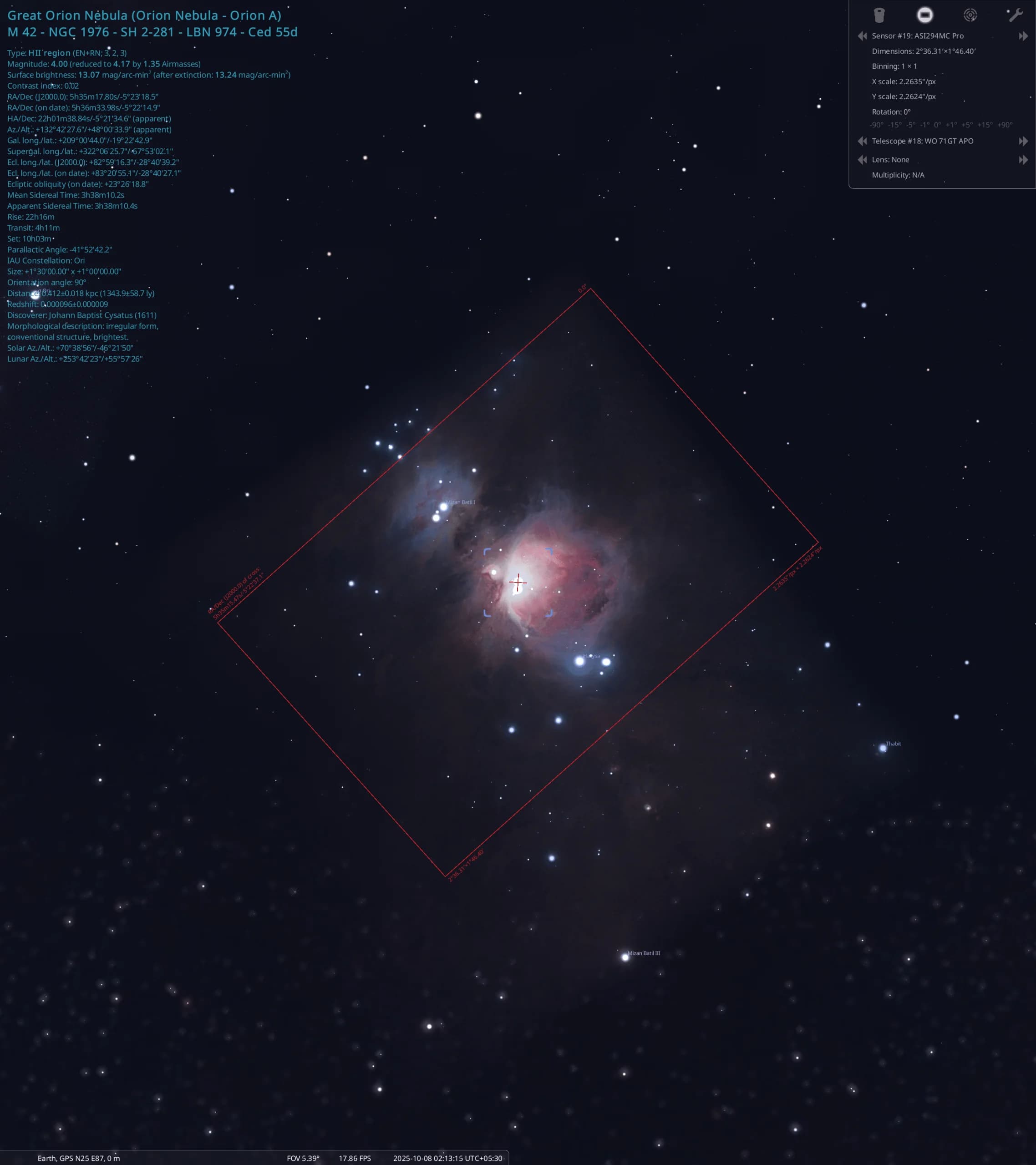
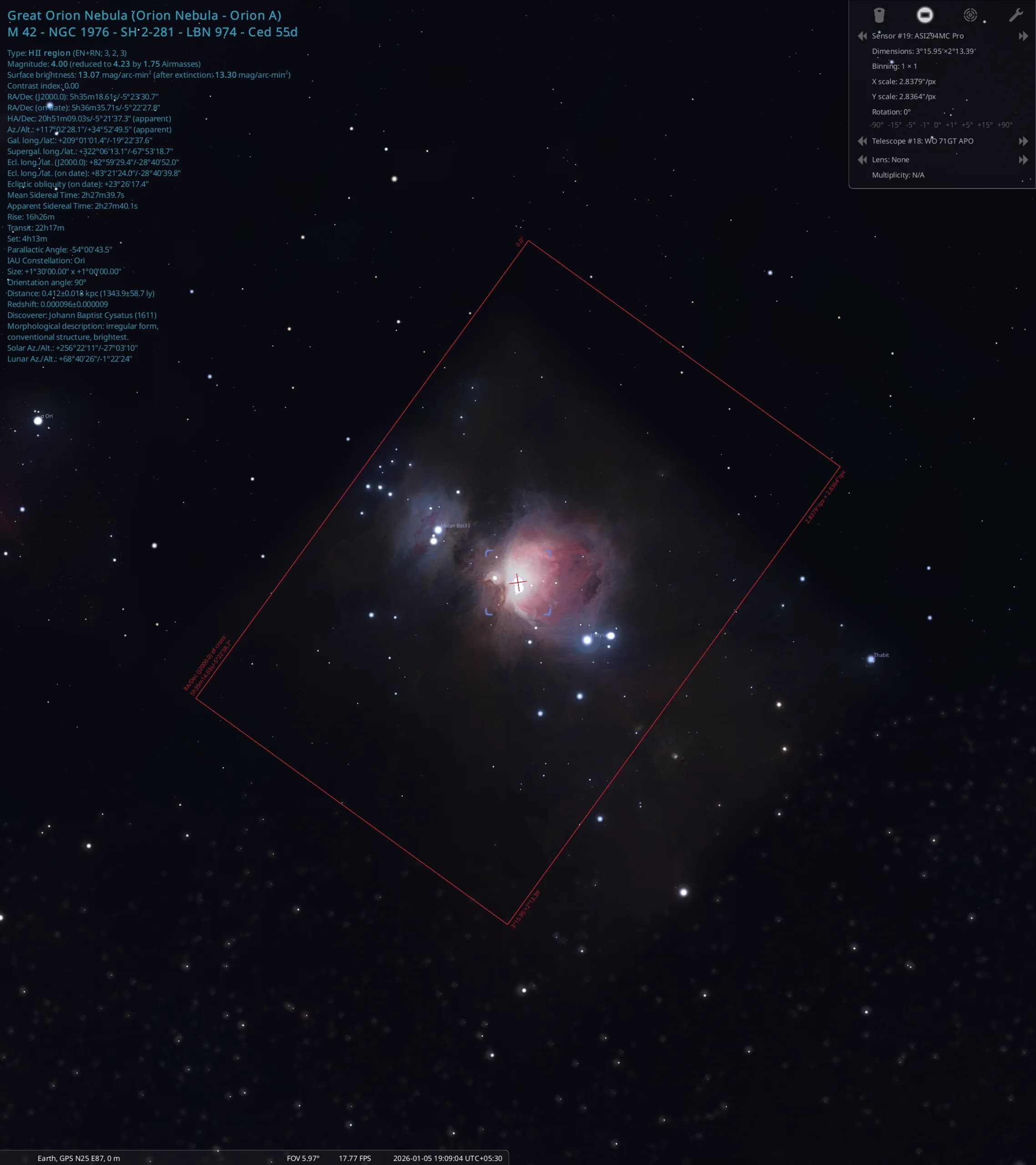
When you look at deep-space targets in planning tools like Stellarium, the angle is a fixed measurement of its apparent size. The Orion Nebula is a massive complex that spans an angle of roughly 1.5 degrees in the night sky. In long-exposure photos, it appears three times larger than the full Moon.
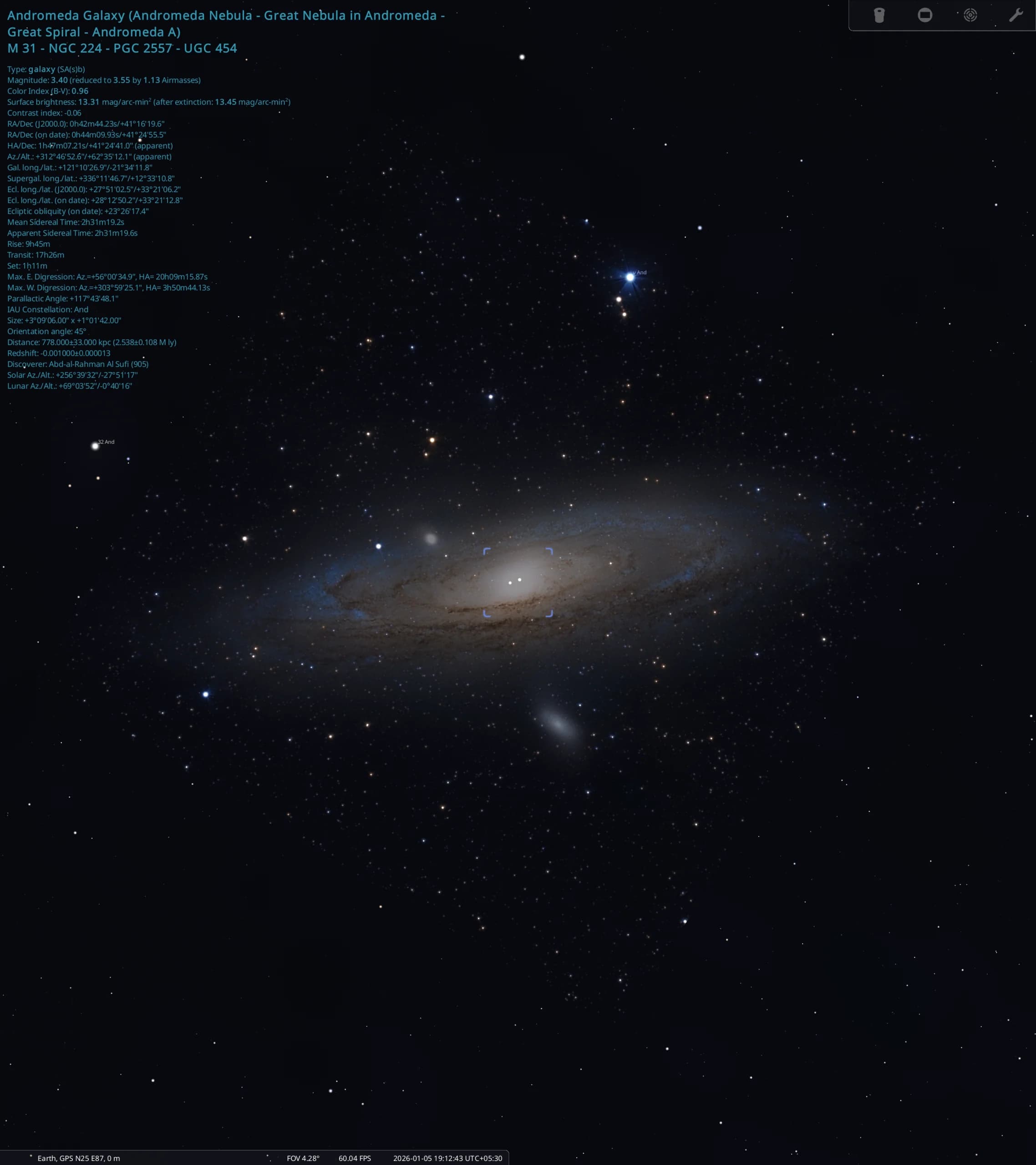
The Andromeda Galaxy is an even more massive target. It spans a huge 3-degree angle across the sky.
Calculating Pixel Scale and Field of View in Astrophotography
Pixel scale is the most critical metric in astrophotography. It determines exactly how much of that sky angle, measured in arcseconds, a single pixel on your sensor sees. This value directly dictates the baseline sharpness of your image.
Here are the formal mathematical formulas we use to calculate these values:
(Measured in arcseconds per pixel)
Coming from the DSLR world, I operated under a massive misconception. I assumed a 500mm lens would inherently provide more "zoom" than a shorter telescope. When I compared my standard Nikon DSLR setup to my new ZWO ASI294MC Pro mounted on my William Optics 71GT APO at 420mm, I fully expected the 500mm camera lens to give me a much tighter view.
I was completely unaware that pixel size is an equally important factor in determining the overall pixel scale. Let us look at the math behind the tradeoffs and how these two fundamentally different setups balanced out to create a nearly identical field of view.
Setup 1: Nikon D5600 + 500mm Lens
- Resolution: 24.2 Megapixels (6000 x 4000)
- Pixel size: 3.9 µm
- Focal Length: 500 mm
- Calculated Pixel Scale: 1.61 arcsec/pixel
- Overall FOV: 2.68° × 1.79°
Setup 2: ASI294MC Pro + WO 71GT APO
- Resolution: 11.7 Megapixels (4144 x 2822)
- Pixel size: 4.63 µm
- Focal Length: 420 mm
- Calculated Pixel Scale: 2.27 arcsec/pixel
- Overall FOV: 2.61° × 1.78°
Dedicated Astronomy Camera Comparison: ZWO ASI533 vs. ASI2600 vs. ASI294MC
To cleanly explain the direct differences and what to expect when choosing a dedicated astronomy camera, let us compare three incredibly popular models on the exact same 420mm telescope focal length.

Notice that the ASI533 and the ASI2600 share the exact same 3.76µm pixel size. Because the physical pixel size is identical, their calculated pixel scale is also identical at roughly 1.84 arcseconds per pixel.
In practical terms, if you take a massive wide-field photo with the ASI2600 and crop it down to the exact dimensions of the ASI533 sensor, the resolution and detail within that cropped area will look completely identical. The ASI533 does not give you any extra zoom. It simply provides a smaller, square field of view due to its physically smaller sensor. They offer different framing options but deliver the exact same baseline sharpness.
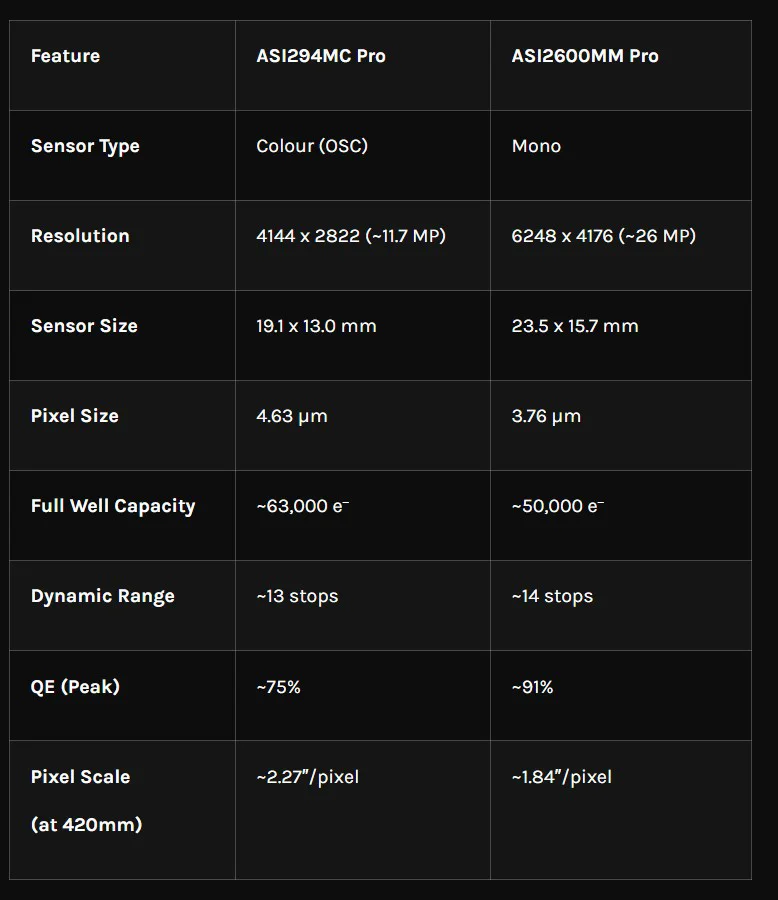
Now look at the ASI294MC Pro. It utilizes larger 4.63µm pixels, resulting in a calculated pixel scale of 2.27 arcseconds per pixel on this 420mm setup.
This is where the ASI2600 shines as a massive mathematical upgrade. The ASI2600 delivers a wider overall field of view alongside a significantly higher base resolution. Because the 2600 operates at a finer pixel scale (1.84"/pixel versus 2.27"/pixel), it packs more detailed spatial information into the exact same area of the sky. If you take an image from the ASI2600 and zoom in to match the specific field of view of the ASI294MC, the ASI2600 data will inherently display more detail and sharper structural boundaries. Zoom does not equal clarity.
Planetary vs. Deep Sky: The ZWO ASI585 vs. ASI533 Debate
If you are just starting out and looking at modern cameras, you will likely find yourself comparing the ASI585 and the ASI533. They sit in a very similar price range. When we look at their physical specifications on the same 420mm telescope, the data tells a very different story.
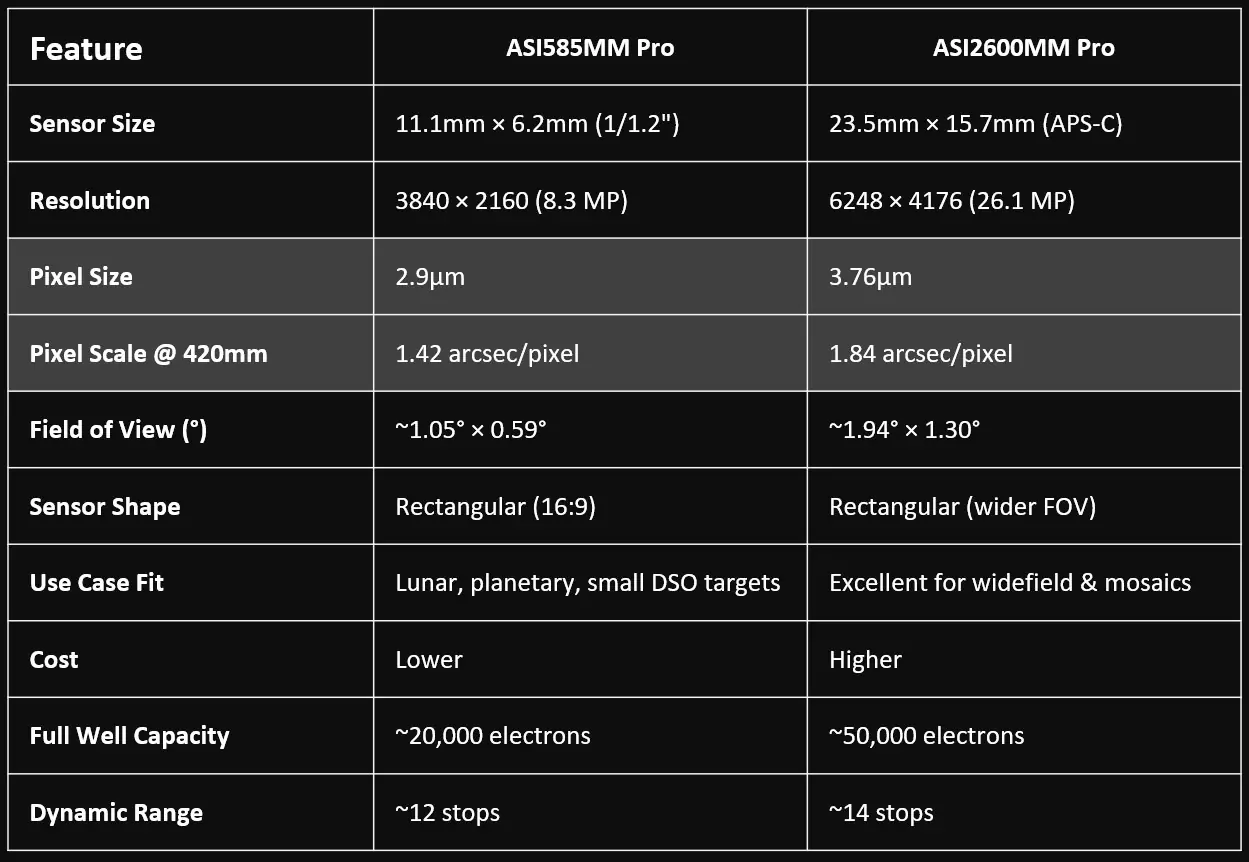
ZWO positions the ASI585 as an all-rounder capable of both planetary and deep-sky imaging. Because it utilizes tiny 2.9µm pixels, it yields a hyper-fine pixel scale of approximately 1.42 arcseconds per pixel at 420mm. This provides excellent theoretical sharpness on smaller targets.
There are fundamental compromises on either side of this debate. The tiny pixels on the ASI585 mean less light-gathering capacity per pixel. This results in a lower full well capacity and reduced dynamic range, meaning bright stars will blow out much faster during long deep-sky exposures. The ASI533 gives you deeper pixels that hold more light for deep-sky objects, but you must work with its square format and slightly lower theoretical resolution.
I am not here to declare a definitive winner between them. Like any person starting out, either one is a highly capable camera. You start with something and learn along the way, much like I did with my ASI294MC. Unless budget is not a concern and you can immediately buy the absolute best of everything, you learn your methods and carefully select your targets until you fully understand the physical limitations of your gear.
Retrospective: Choosing Your First Astrophotography Camera
As I look back on my own entry into this hobby, I realize that starting with the ASI294MC Pro was one of the best things that happened to me, regardless of its quirks.
I did not spend weeks analyzing sensor specifications or pixel scales. I simply got started. I never measured my progress against other astrophotographers or chased APOD features. I was chasing clarity of image and of understanding. I wanted to know exactly what my equipment could do, not what it lacked.
I worked around hardware limitations by choosing targets that actively matched my gear. The physical combination of telescope focal length and camera matters far more than raw sensor specifications alone. Concepts like pixel scale help fine-tune your expectations, but they do not define your enjoyment.
If I were to rewind, would I have gone for the ASI2600MM instead of the 294MC? Maybe. But even the ASI533 or ASI585 would have taken me on an equally rewarding path. It is not about the gear. It is about learning how to use the data you have. The sky is not going anywhere, and neither is the thrill of capturing it.