M81 & M82: A Widefield Encounter in Ursa Major
16 Feb 2025By Akshay Kumar
M81 and M82: A Galactic Encounter in Ursa Major
Earlier each night, the primary target had been the hydrogen-rich fields of the Seagull Nebula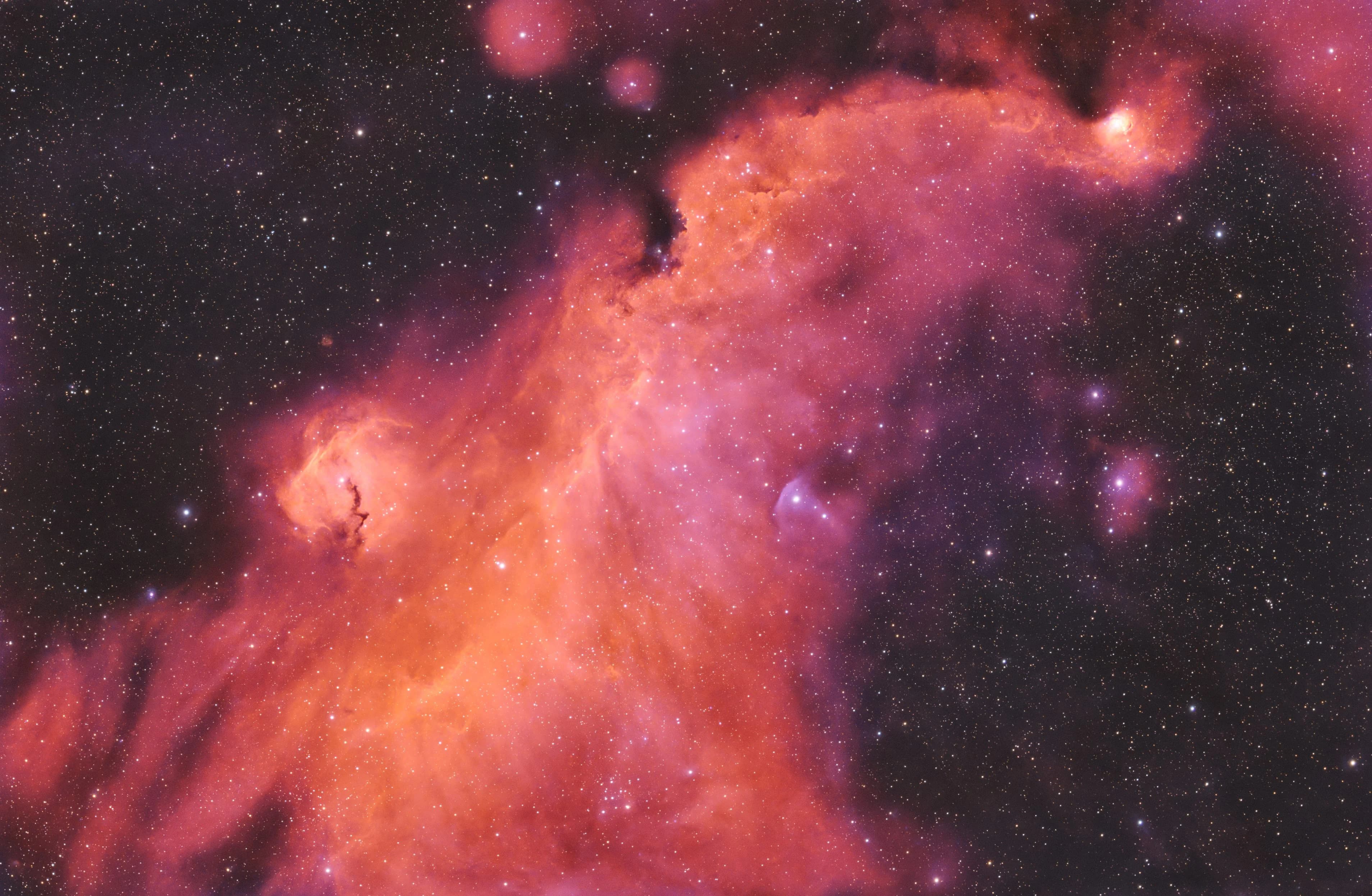 Captured over three nights under Bortle 8 skies. Once that region dipped lower into the atmospheric gradients, the telescope slewed northward to Ursa Major. Between 2:00 AM and 4:30 AM, Messier 81 and Messier 82 would rise to a steady altitude of 40 to 50 degrees. This provided a much cleaner window through the Bhagalpur light dome for extended exposures.
Located approximately 12 million light-years from Earth, these two galaxies are locked in a mutual gravitational interaction. M81, commonly known as Bode's Galaxy, spans nearly 90,000 light-years across. It maintains a highly structured spiral morphology with tightly wound dust lanes. In stark contrast, the smaller M82, at roughly 37,000 light-years in diameter, exhibits an irregular, disrupted structure. The tidal forces from M81 are actively compressing gas within M82, triggering a massive wave of star formation and turbulent supernova events at its core.
Framing M81 and M82: Widefield Constraints & Rotation Errors
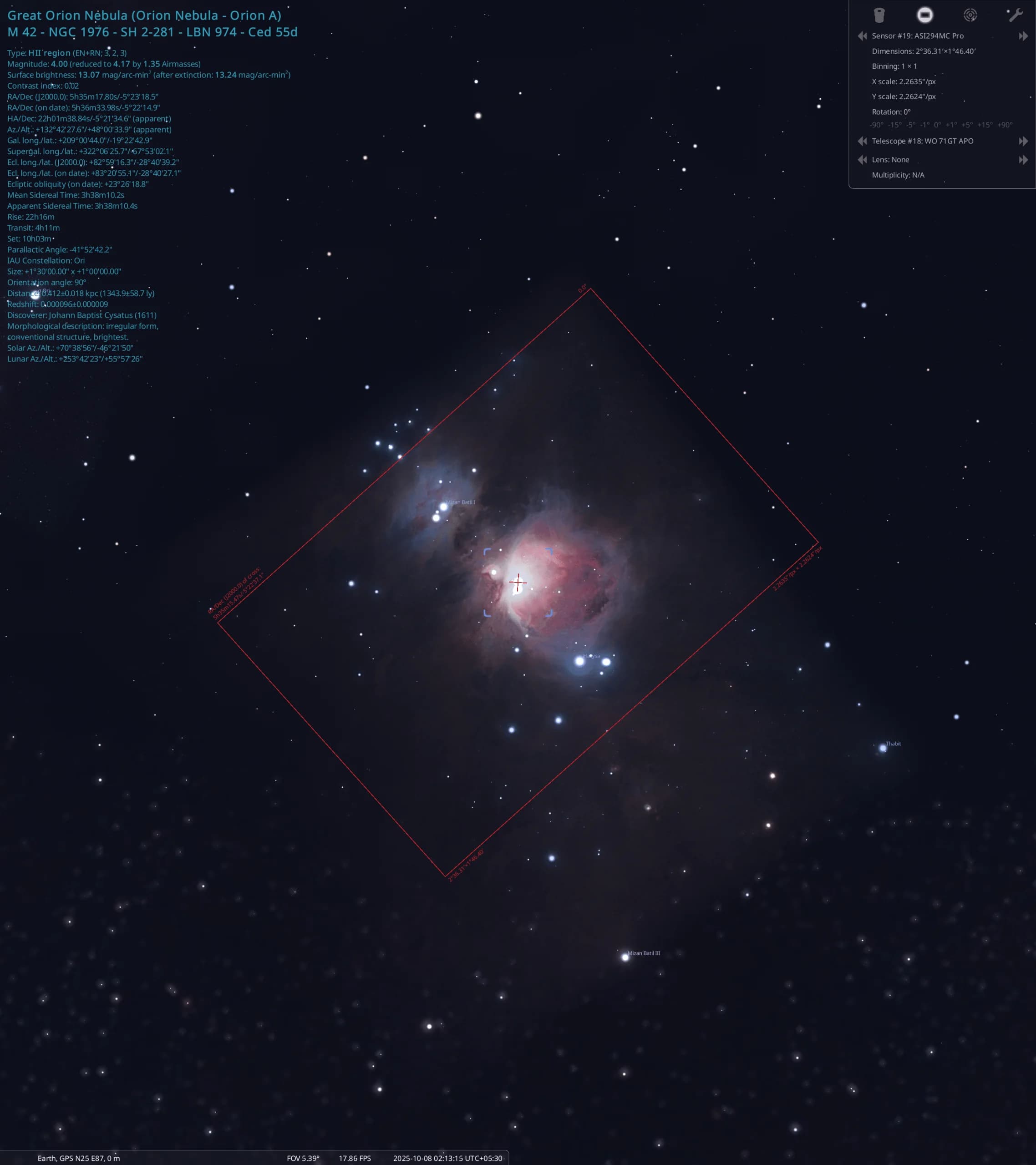
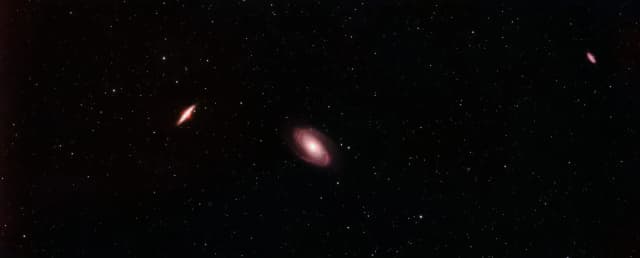
The William Optics 71GT APO paired with a 0.8x focal reducer yields a wide field of view. This optical configuration excels for expansive emission nebulae but presents a distinct challenge when attempting to resolve the structural details of distant galaxies. Framing M81 and M82 at this focal length meant accepting a loss of fine core resolution in favor of capturing their relative proximity and the vast surrounding star field.
The acquisition process itself introduced immediate hurdles. The entire first night of data collection had to be scrapped due to a mechanical oversight. A camera rotation error left the ASI294MC Pro misaligned, placing the galaxy pair at an awkward, unsalvageable angle within the frame. In astrophotography, precision at the sensor plane is absolute. Correcting this required a manual adjustment to the imaging train and a complete restart of the sequence the following night.
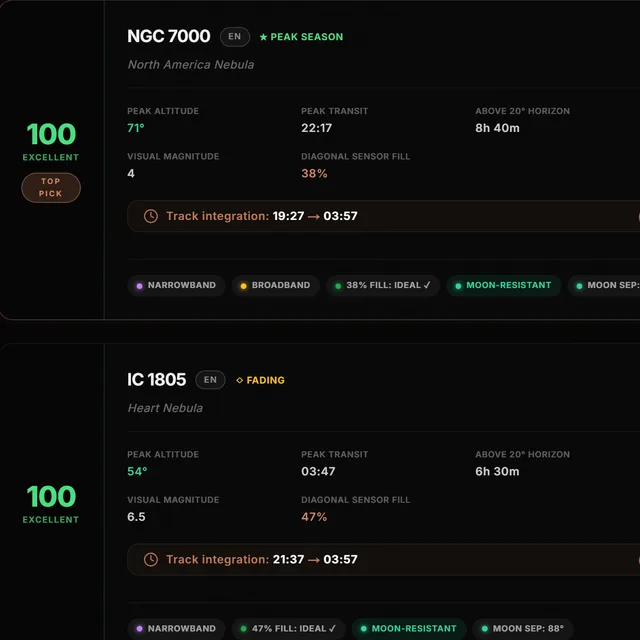
To prevent these precise framing and rotation errors from ruining future integrations, I developed a custom application specifically for this purpose. The Target Selection Dashboard allows users to select targets based on specific camera gear and visualize the exact field of view based on sensor rotation.
Isolating M82's Starburst Core with Narrowband Data
Over the span of three clear nights in February 2025, the system gathered nearly 19 hours of total exposure. Most of this was unfiltered broadband data to capture the natural hues of the galaxies and the surrounding star field. On the final night, an Optolong L-eXtreme filter was threaded into the imaging train. The goal was to isolate the hydrogen-alpha outflows erupting from the turbulent core of M82.
Processing this mixed dataset presented a specific technical challenge. While the narrowband signal successfully recorded the intense starburst activity, seamlessly blending it back into a standard RGB composite is notoriously difficult. The isolated hydrogen-alpha details often get overpowered or heavily overlapped by the broader red channel data during the final stretching phases. Despite this blending difficulty, pulling the star field out entirely allows the underlying structure, dust lanes, and the distinct core of the Cigar Galaxy to stand out clearly against the dark background.
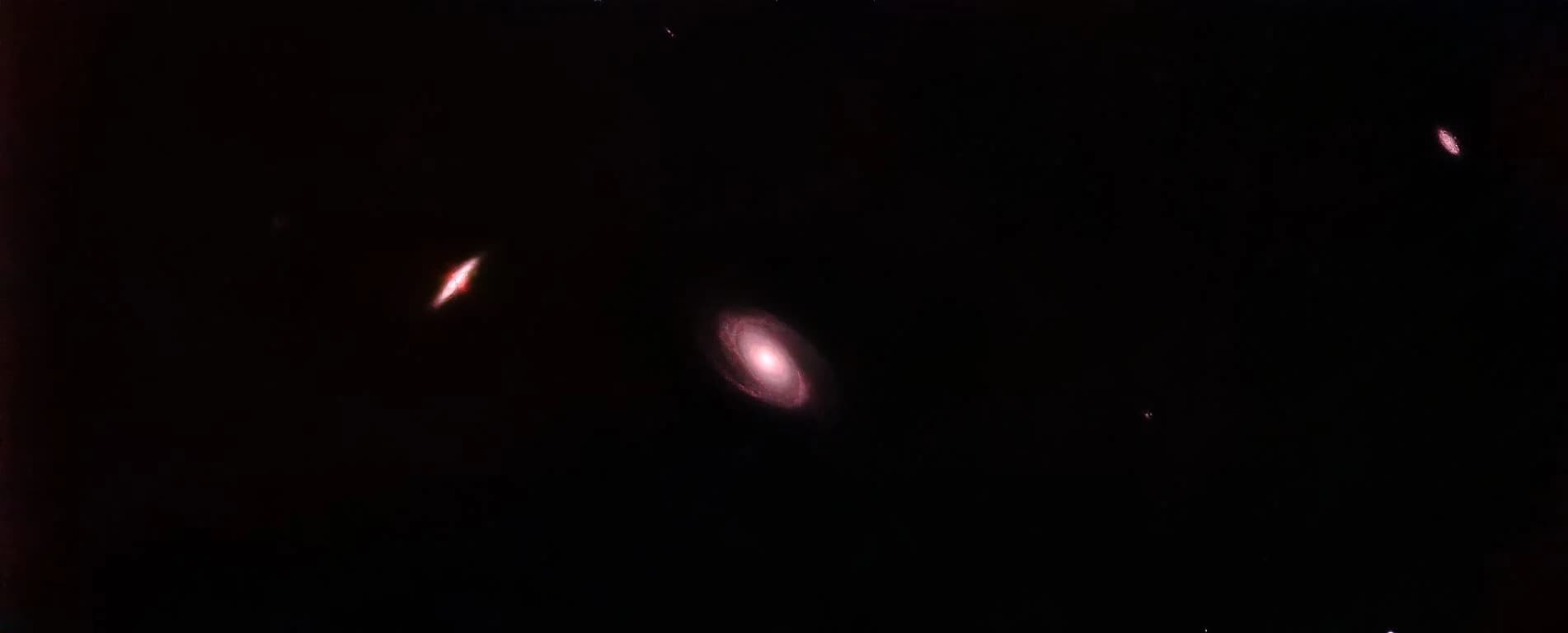
Navigating the Ursa Major Field
The final image serves as a comprehensive map of this region in Ursa Major. Exploring the plate-solved field reveals dozens of faint background galaxies scattered across the frame, highlighting the sheer density of targets in this sector of the sky. However, the limitations of the William Optics 71GT APO at a reduced focal length become apparent here. While the plate solver identifies numerous objects from the Principal Galaxies Catalogue (PGC), most remain invisible or appear as mere smudges in the final integration due to their extreme faintness and small apparent size.
The telescope easily resolves the primary structural features of M81 and M82, alongside the distinct glow of NGC 2976 on the far right edge of the frame. The prominent star TYC4383-1056-1 anchors the lower right quadrant, providing a bright reference point among the distant galactic signals. Capturing this widefield view under the heavy light pollution of Bhagalpur was a demanding technical exercise. From managing exact camera rotation to integrating isolated narrowband data over three nights, the result stands as a precise record of the Ursa Major neighborhood.
- Integration
- 19 Hours
- Telescope
- William Optics 71GT APO + 0.8x Reducer
- Camera
- ZWO ASI294MC Pro
- Mount
- iOptron CEM40
- Filters
- Optolong L-eXtreme (Partial)
- Guiding
- WO 50mm f/4 + ASI120MM
- Location
- Bortle 8 (Bhagalpur)